What does it cost to run an AI agent in production? About €4 a month
Two Railway services, one cron, a webhook, a watchdog and a cost log. The real numbers from the Sunday slides agent's first weeks in production, including the Thursday it failed.
Part 1 was the story and Part 2 was the guardrails. This part is about operations: what runs where, how I know it ran, how fast it is, and what each piece costs. Every number below is measured in production from 8 to 23 October 2026, unless I say it's an estimate.
What runs where
| plans-api | weekly-build | |
|---|---|---|
| Type | Web service, always on | Cron job, restart policy NEVER |
| Does | WhatsApp webhook, /health, slide plans over HTTP | Thursday build, Friday retry, Monday reminders |
| Schedule | n/a | 0 8,17 * * 1,4,5 UTC; wake-ups that aren't due exit at once |
| Storage | 500 MB volume: chapter cache, cost log, conversation state | None; it refetches what it needs |
| Runtime | python:3.12-slim, FastAPI on uvicorn | Same image |
Both services deploy from main on push. Infrastructure is code (.railway/railway.py), and secrets are marked preserve(), so applying the config never writes or clears them. railway config plan must say already up to date before anything is applied.
Two choices worth pointing out:
- The cron is idempotent by design. The Friday run checks whether Thursday's deck exists and exits if it does. That's why Friday runs show up as 2–12 second "builds" below.
- Heavy WhatsApp work runs in a short-lived child process. The web service stays small, and the memory a slide rebuild needs is released as soon as it's done.
How I know it ran: Cronitor
A scheduled job that fails silently is worse than no job, because everyone thinks it ran. So there are two monitors, both on Cronitor's free plan, both alerting the coordinator by email:
- Job monitor for
weekly-build: schedule0 17 * * 4,5UTC with a 30-minute grace period. The build reportsrun, thencompleteorfailwith the reason. If it doesn't report at all, that's a missed alert. - HTTP check on
plans-api /healthevery 5 minutes, from Europe and the US. If the webhook is down, WhatsApp replies silently go nowhere, so this one matters as much as the build.
The telemetry client is deliberately tiny, and it can never break the build:
class Job:
    def __init__(self, url: str):
        self.url = url
        self.series = uuid.uuid4().hex  # pairs this run's events

    def ping(self, state: str, message: str = "") -> None:
        if not self.url:
            return
        params = {"state": state, "series": self.series}
        if message:
            params["message"] = message[:1500]
        with contextlib.suppress(requests.RequestException):
            requests.get(self.url, params=params, timeout=10)
The series id pairs each run with its complete or fail, so Cronitor can compute durations. Test builds don't report, so the dashboard only shows real Sundays.
The Thursday it failed
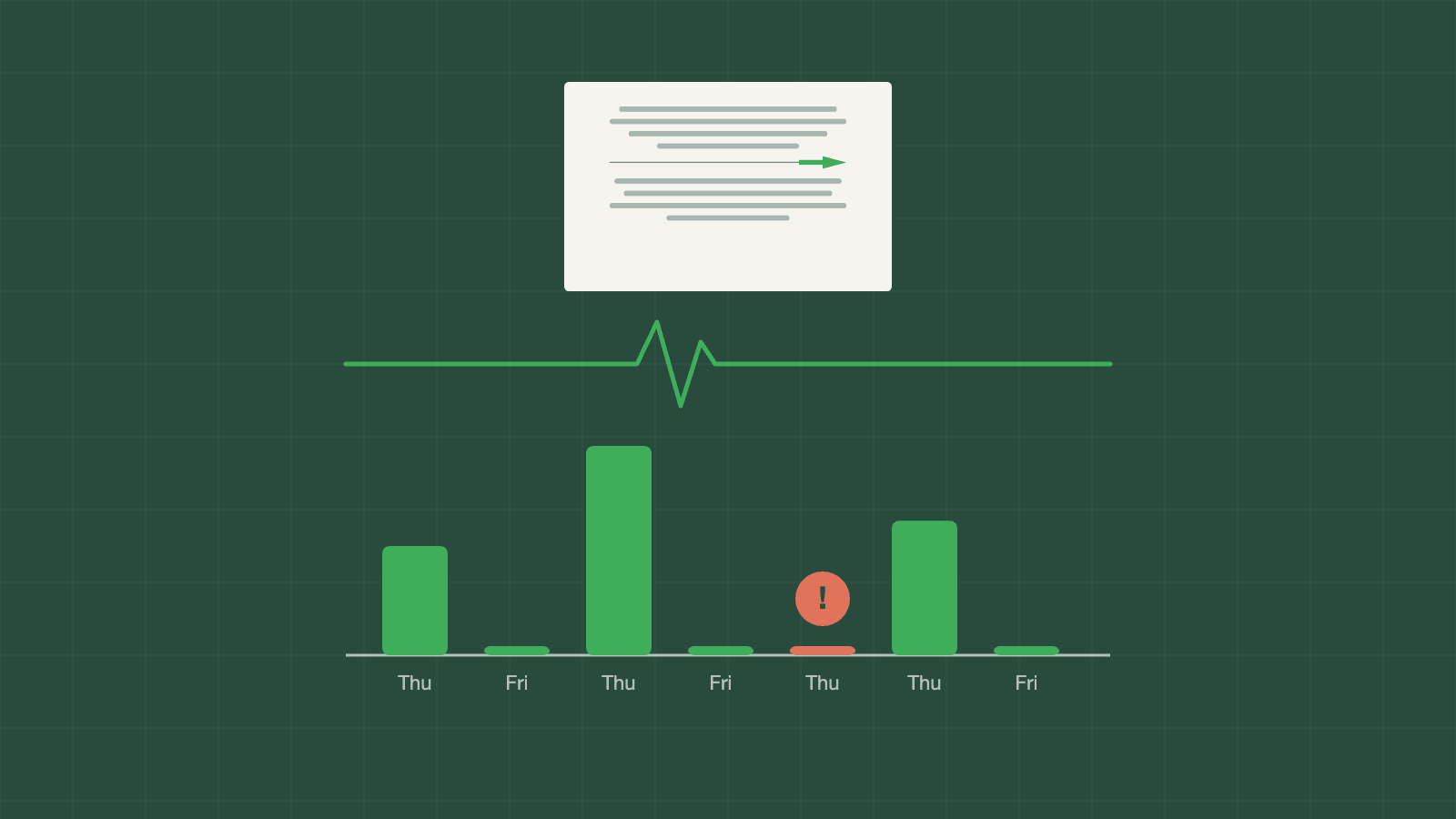
On Thursday 22 October at 17:01 UTC the build failed after 5 seconds:
RefreshError: ('invalid_grant: Token has been expired or revoked.', …)The Google OAuth refresh token had stopped working. Here's what happened next:
- 17:01 UTC: Cronitor emailed the coordinator within seconds, with the exception in the email. Nobody had to dig through logs to learn it was an auth problem, not a code problem.
- That evening: I re-authorised the Google account, updated the three Railway variables and ran the build by hand. It completed at 20:13 UTC in 3 min 16 s.
- Friday 17:03 UTC: the scheduled retry saw the deck already existed and exited in 4.4 s.
The slide preparer had their review on Thursday evening as usual, three hours late. Without the monitor, the first sign would have been an empty Sunday folder.
The lesson is an unglamorous one: the most likely failure of an agent isn't the AI, it's the plumbing around it. Expired tokens, a changed web page, a WhatsApp template paused by Meta. Each of those has a line in the runbook, and each produces an error message a non-engineer can act on.
Latency
Nobody needs the Sunday slides in milliseconds. What matters is that each step is fast enough for its human on the other end.
Weekly build (Cronitor job durations):
| Run | Duration | What it did |
|---|---|---|
| Thu 8 Oct | 2 min 39 s | Full build |
| Fri 9 Oct | 11.5 s | Retry; deck already existed |
| Thu 15 Oct | 5 min 05 s | Full build (first week with songs) |
| Fri 16 Oct | 2.3 s | Retry, no-op |
| Thu 22 Oct | 5.2 s | Failed: Google token revoked |
| Thu 22 Oct | 3 min 16 s | Manual re-run after re-auth |
| Fri 23 Oct | 4.4 s | Retry, no-op |
Most of a full build is spent waiting on APIs, not computing. That means Google Slides batch updates, exporting the review PDF, and one or two Claude design calls of roughly 28k input tokens with images.
Web service (plans-api):
| Metric | Value |
|---|---|
| /health round trip, all probes (p50 / p90) | ≈ 0.31 s / 0.39 s |
| From Cronitor's EU probes (p50) | ≈ 0.36 s |
| From Cronitor's US probes (p50) | ≈ 0.25 s |
| Failed health checks | 1 of ≈ 4,500 (≈ 99.98%) |
| WhatsApp webhook server time (p50) | 24–38 ms |
| Memory (7-day average / peak) | ≈ 97 MB / ≈ 330 MB |
| CPU (7-day average) | ≈ 0.01 vCPU |
The US probes are faster than the EU ones because the service runs in a US region while its users are in The Hague. At these response times nobody notices, but it's on the list.
The webhook acknowledges first and works later. Meta wants a fast 200, so the handler checks the X-Hub-Signature-256 HMAC (in constant time), queues a background task and returns:
if not hmac.compare_digest((x_hub_signature_256 or "").encode(), expected.encode()):
    raise HTTPException(401, "bad signature")
...
background.add_task(_process_replies)  # answer Meta now; act on the message afterwards
The background task waits about 8 seconds, then runs the work in a subprocess with a 30-minute timeout. It waits because a PowerPoint and the text that goes with it ("put these after the sermon") arrive as separate WhatsApp messages and should be handled together. Slide changes take a minute or two, so the agent says so first ("give me about 2 minutes ⏳") and then sends a picture of only the slides that changed.
Songs follow the doc with a check every 3 minutes. A hymn number typed into the Google Doc reaches the deck within 3–6 minutes. That polling costs about $0.22 a month.
What it costs
Measured on 12 October 2026, from the agent's own cost log and railway usage. $1 ≈ €0.86.
| Item | Unit cost (measured) | Per month |
|---|---|---|
| Claude: weekly design pass (Sonnet) | ≈ $0.04 per round, 1–2 rounds per build | €0.30 |
| Claude: reading WhatsApp messages (Sonnet) | ≈ $0.018 per message (≈ 8.3k in, 0.14k out) | €1.00 |
| Claude: design after a change (sermon PowerPoint) | ≈ $0.04 per round, ≈ 6 a month | €0.20 |
| Claude: wording replies (Haiku) + song ideas | $0.0005 per reply; ≈ $0.01 per Sunday | €0.10 |
| Railway: this project's usage | memory is almost all of it | €0.60 |
| WhatsApp template messages | ≈ €0.03–0.055 each, ≈ 40 a month with the full roster | €1.20–2.20 |
| Google APIs, GitHub, Cronitor, Bible sources | free tiers | €0 |
| Total | €3.40–4.40 |
The Railway Hobby fee ($5, with $5 of usage included) is shared with this website, so I don't count it here. If you do, the total is €7.10–8.10. The budget I set at the start was under €15 a month.
How it got there
The first estimate, before any optimisation, was €12.40–15.20 a month: uncomfortably close to the budget. The changes, in order of impact:
- Opus → Sonnet for the designer and for reading messages. That halved the per-token price, and the quality was fine for "is this readable from the back row?" and "what does this person want?".
- Design only the slides that changed. Each deck starts from last Sunday's already-designed deck, so most slides need nothing. The design pass went from $0.46–0.55 to about $0.08 per build.
- Smaller images (512 px) sent to the model. That's plenty to judge contrast and overflow.
- The child process for heavy work, which keeps the always-on service's memory, and so its Railway bill, low.
I also looked at what not to optimise:
| Idea | Saving | Verdict |
|---|---|---|
| Prompt caching for messages | ≤ €0.20 a month | Messages arrive minutes to hours apart, so the cache would mostly miss |
| Haiku for reading messages | ≈ €0.50 a month | Not now: messages come in five languages, often mixed, and understanding them is the part that must not get worse |
| Scale plans-api to zero, or Cloud Run | ≤ €0.60 a month | Cold starts on a webhook, for pennies |
Knowing what it costs, every month
You can't keep a budget you can't see. So:
- Every Claude call is appended to
llm_costs.jsonlon the volume: model, tokens in and out, and dollars. - Every job adds its total to the month and stores it on the church's Drive folder as a hidden property (
claude_usd_2026-10). The cron service has no volume, so a local log file would vanish after each run. - Each job's log ends with "Claude: $…; this month so far: $…", and the coordinator's Monday summary ends with the month so far.
- Test builds aren't counted, so the number is what real Sundays cost.
Like the monitor, the bookkeeping is wrapped so it can never stop a job. If Drive is unavailable, the total just isn't updated that time.
There was also a one-off cost: about $18 to build the song library from the scanned hymnal. That's a good reminder to give one-off tools their own API key with their own limit.
Degrading gracefully
Every external dependency has a defined "what happens if it's down":
| If this fails | What happens |
|---|---|
| Anthropic API (outage, no credit) | The deck is still built, just without the design pass. Replies are forwarded to the coordinator instead. |
| Bible source changes its HTML | SourceError, build stops, Cronitor emails. A regression script replays all 54 Sundays in the doc. |
| Google token revoked | Build fails fast with invalid_grant (see above). |
| Apps Script copy unavailable | PowerPoint slides go in as pictures instead of editable slides, and the reply says so. |
| WhatsApp template paused by Meta | Review not sent; the build log says why. |
| Readings not in the doc yet | Thursday reports "Not built: no readings". Friday retries. |
What I'd do next
- A usage limit on Railway and a spending cap on the Anthropic key. Not for the normal bill, which is tiny, but for a runaway loop.
- An alert on low Anthropic credit, before it turns into a week without a design pass.
- Move the service to an EU region, closer to its users.
- A church-owned WhatsApp number instead of the current test number.
None of this is exotic. That's the point. The AI part of the agent got most of the attention while building it, but most of what makes it dependable is ordinary engineering: idempotent jobs, alerts with the reason in them, a cost log, and a runbook a coordinator can follow.